



Bali Villa Market 2026: Registered vs Unregistered & What Owners Must Do
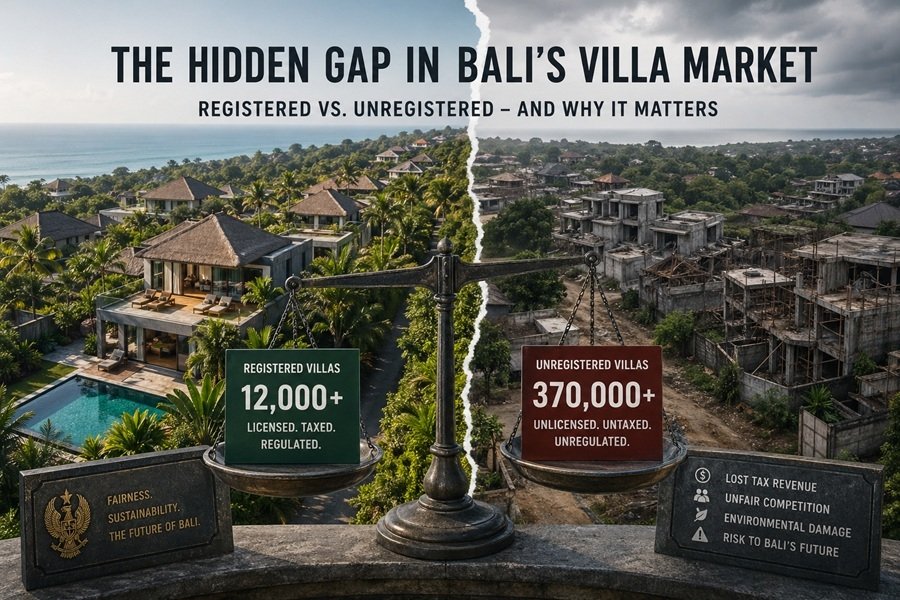
The villa market in Bali is entering a defining moment. For years, growth has been driven by demand, lifestyle appeal, and investment momentum. But in 2026, a more critical issue has come into focus: the massive gap between registered and unregistered villas—and what that means for owners, especially in areas like Balangan Beach.
Recent industry data reveals a striking imbalance. Only around 12,000 villas are officially registered, while an estimated 370,000 units are actively listed or operating across platforms. This suggests that the majority of Bali’s villa market may still operate in a grey or non-compliant space.
Even more grounded estimates indicate that while about 5,000+ villas are formally identified within official accommodation data, the real number of active listings could be four to five times higher. The message is clear: the market is heavily oversupplied—and largely unregulated.
For villas in Balangan, this is not just data. It directly affects how the business performs today and how it must evolve for the future.
The most immediate impact of this imbalance is pricing pressure. Thousands of unregistered villas, operating without taxes or full compliance costs, are able to undercut the market. This has already contributed to a measurable decline in both occupancy and average daily rates across Bali, with projections showing around a 10% drop in each.
This creates a difficult environment for professional operators. Competing on price alone is no longer sustainable. Instead, the market is shifting toward a new reality where only well-managed, differentiated villas maintain strong performance.
So what should villa owners do to maximize earnings in this environment?
The first shift is strategic positioning. The era of “generic villas” is ending. Properties that look the same, offer similar amenities, and rely only on location are becoming interchangeable. Owners must invest in identity—whether through design, experience, or niche targeting. Guests are no longer just booking a villa; they are choosing a story, a vibe, and a reason to return.
The second focus is operational excellence. In a crowded market, guest reviews and repeat bookings become critical. Professional management, strong service standards, and consistent maintenance are no longer optional—they are the baseline for survival. Villas that operate like hospitality businesses, not passive investments, are the ones that continue to perform.
The third is pricing intelligence. Instead of reacting to competitors by lowering rates, owners must adopt dynamic pricing strategies based on demand, seasonality, and booking behavior. The goal is not to be the cheapest—but to be the most valuable option within a specific segment.
The fourth—and increasingly important—is compliance. In the past, many owners treated licensing as optional or secondary. In 2026, that is no longer viable. The Indonesian government has introduced strict integration between licensing systems and online platforms. Villas without verified business registration (NIB) and proper permits risk being removed entirely from platforms like Airbnb and Booking.com.
This leads to the most important question: what will the government do next?
All signals point toward stronger enforcement and market cleanup.
Authorities have already implemented a March 2026 compliance milestone, requiring all short-term rental properties to meet licensing, zoning, and safety requirements. This is not just policy—it is being enforced through digital systems that connect government databases with global booking platforms.
At the same time, zoning regulations are tightening. New frameworks ensure that villas can only operate in designated tourism zones, with automatic verification systems rejecting non-compliant developments. This is expected to significantly reduce illegal construction and limit future oversupply.
The likely next phase is a combination of digital enforcement and physical action. Non-compliant villas may be delisted, fined, or even shut down. While this creates short-term uncertainty, it also points toward long-term stabilization.
For Villa Poetra Balangan, this shift presents a clear opportunity. As thousands of unregistered villas face pressure to comply or exit the market, legally operated and professionally managed properties will stand out. Visibility will improve, competition will become more balanced, and pricing power may gradually return.
In many ways, Bali is moving from a “wild growth” phase into a “professional market” phase. The winners will not be those who entered early—but those who adapt fastest.
The gap between registered and unregistered villas may have created today’s challenges, but it is also setting the stage for tomorrow’s reset. For owners willing to evolve, this transition is not a threat—it is a turning point.